L0-03 · Watch a change
Write down what you see before and after a change. Save your ideas about why for later.
 Level 0 · Grades 1–3 · about 30 minutes
Big idea. Write down what you see before and after a change. Save your ideas about why for later.
Before this lesson. L0-01
Grown-ups. The guide for adults is at the end of this page.
What you will learn
I can draw and write what I see at different times.
I can tell what I saw apart from why I think it happened.
I can write my why ideas in their own place.
Story: The crying ice cube
Maya puts an ice cube on a plate. After a while, Leo points at it. “Look, the ice cube is sad. It is crying!”
Maya laughs. “Ice cubes do not feel sad. Let’s write only what we can see.” She looks closely. She writes, “The cube is smaller. There is water on the plate.”
Every five minutes, they observe the cube again. Each time, Maya draws it and writes what she sees. The cube gets smaller and rounder. The puddle gets bigger.
Leo has ideas about why. “Maybe the room is warm. Maybe the plate is warm.” Maya says, “Good ideas! Let’s put them in a different column.” Now they have two lists: what they saw, and what they think made it happen.
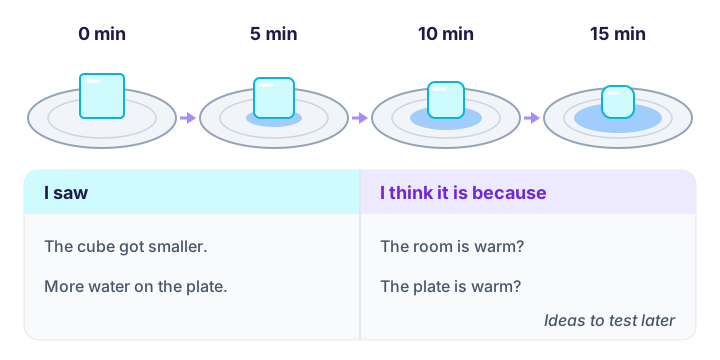
The cube gets smaller and the puddle gets bigger. What they saw goes on the left. Their why ideas go on the right.
Hands-on: Ice cube watch
About 20 minutes.
You need:
One ice cube
A plate
A clock or timer
Paper and a pencil
Steps:
Fold your paper in half. On the left side, write “I saw.” On the right side, write “I think it is because.”
Put the ice cube on the plate. Set the plate on a table.
Observe the cube right away. This is 0 minutes. Draw it and write one thing you see on the left side.
Set the timer for 5 minutes. When it rings, draw the cube again and write what you see now.
Do it again at 10 minutes and at 15 minutes.
Look at your drawings. What changed? What stayed the same?
Now think about why the ice changed. Write your ideas on the right side only.
Practice together
Leo says, “The ice cube got smaller because the room is warm.” Which part goes in the I saw column? Which part goes in the other column?
Check your answer
“The ice cube got smaller” goes in I saw, because you can see it. “Because the room is warm” is an idea about why, so it goes in the other column.
Try it yourself
1. You leave a piece of bread out on a plate overnight. In the morning it is hard. Write one I saw sentence.
Check your answer
Something like “The bread is hard now” or “The bread was soft before and is hard now.” It tells what you saw, not why.
2. Sam says, “The puddle dried up because the sun took the water.” Is that what Sam saw, or an idea about why?
Check your answer
It is both. “The puddle dried up” is what Sam saw. “Because the sun took the water” is an idea about why, so it goes in the other column.
Talk about it
Why did Maya say ice cubes do not feel sad?
Why is it useful to keep your why ideas in a different place?
What else changes when you wait and watch? How could you observe it?
Check yourself
1. Which sentence goes in the I saw column?
A. The warm room made the ice melt.
B. The ice cube is sad.
C. The ice cube got smaller.
Show the answer
C. The ice cube got smaller.
You can see the cube get smaller. A cube cannot feel sad. The warm room is an idea about why, so it goes in the other column.
2. Leo writes, “The plate made the ice melt.” Where should this go?
A. In the I saw column
B. In the I think it is because column
C. Nowhere, because guesses are bad
Show the answer
B. In the I think it is because column
It is an idea about why. Ideas are good! They go in their own column, so you can test them later.
3. Remember Lesson 2. You sort socks by color. You find a sock with red and blue stripes. What should your rule say? (Review of L0-02)
A. Leave it out, because it does not fit
B. Put it in red one day and blue the next
C. Where tricky socks go, like a two colors group
Show the answer
C. Where tricky socks go, like a two colors group
A clear rule says where every sock goes, even the tricky ones. Then each sock has just one place.
Words to know
- observe
- To look closely and notice what is there.
- melt
- When something solid, like ice or butter, warms up and turns runny.
- column
- A part of a page that goes from top to bottom.
For grown-ups: about this lesson
Why it matters. Telling an observation apart from an explanation is a core habit in the K-2 science practices, where children make observations to collect data and then use evidence to build explanations NGSS Lead States, 2013. Looking at fixed times (0, 5, 10, and 15 minutes) makes before and after concrete. The ice melts because heat moves into it from the warmer air and plate. The child does not need that answer yet; confirm it after their own ideas are written down.
Watch for these mix-ups.
The ice is sad or wants to melt. (Gently ask: what can you see? Feelings words describe people and animals, not ice.)
The ice disappears. (The water is right there on the plate; point to the puddle.)
A guess is only allowed if you are sure. (Guesses are welcome; they simply go in their own column until they are tested.)
To make it easier. Observe only at 0 and 15 minutes. The child draws, and the grown-up writes the words the child says.
To make it harder. Put a second ice cube on a plate in a sunny spot or near a warm window. Before you test it, ask the child to say which cube will melt first and why, and write that idea in the right column. This leads into fair tests in Lesson 4.
Limits. Watching a change shows what happened, not why. The ideas in the right column stay untested until a fair test in Lesson 4. How fast the ice melts depends on the size of the cube and how warm the room is, so results will differ from home to home.
On the computer. Grown-ups can see where this idea leads later in Lab: Confounding and intervention, written for older learners.
Sources for this guide. NGSS Lead States, 2013
Next: L0-04 · Compare fairly
- NGSS Lead States. (2013). Appendix F: Science and Engineering Practices in the NGSS. Next Generation Science Standards. https://www.nextgenscience.org/sites/default/files/Appendix%20F%20%20Science%20and%20Engineering%20Practices%20in%20the%20NGSS%20-%20FINAL%20060513.pdf