L0-07 · Use light to ask a question
We see things when light from them reaches our eyes. Some things let light through, some block it, and some bounce it back.
 Level 0 · Grades 1–3 · about 30 minutes
Big idea. We see things when light from them reaches our eyes. Some things let light through, some block it, and some bounce it back.
Before this lesson. L0-03, L0-04
Grown-ups. The guide for adults is at the end of this page.
What you will learn
I can explain why I cannot see things in a very dark room.
I can test what different things do to a flashlight beam.
I can write what I saw before I guess why.
Story: The lost dinosaur
It is bedtime and the room is very dark. Leo drops his toy dinosaur. He feels around on the floor, slowly. “I cannot see it anywhere!”
Maya clicks on a flashlight. The beam lands on the dinosaur. “There it is!” says Leo. Maya says, “Light from the flashlight bounced off your dinosaur and into your eyes. In the dark, no light was coming from it.”
Then they wonder what other things do to light. They tape white paper to the wall. They hold clear plastic, wax paper, cardboard, and a small mirror in the beam, one at a time.
When they hold up the cardboard, Leo says, “The cardboard ate the light!” Maya shakes her head. “Let’s write what we saw first. I saw no spot on the paper.” They save the why for later.
The clear plastic left a bright spot. The wax paper left a soft, dim spot. The mirror sent the spot up to the ceiling. Mirrors reflect light, so the spot bounced back toward their side of the room.
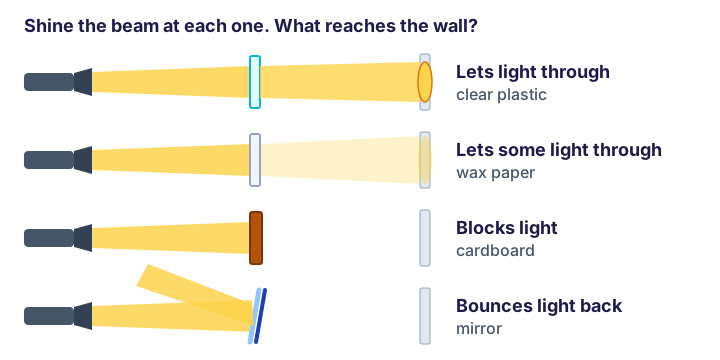
Same flashlight, four different things. Look at what reaches the wall.
Hands-on: Flashlight test
About 20 minutes.
You need:
A flashlight
A sheet of white paper and some tape
Clear plastic, like a clear food lid or a sheet protector
Wax paper or baking paper
A piece of cardboard
A small mirror, plastic if you have one
Paper and a pencil
Steps:
Tape the white paper to a wall. Make the room dim, but not totally dark.
Make a chart. Write the four things down the side. Make two columns: My guess and I saw.
Before you test, write your guess for each thing. Will light go through?
Stand one big step from the wall. Shine the flashlight at the white paper. Look at the bright spot.
Hold each thing in the beam, one at a time. Keep the flashlight in the same spot each time.
Look at the paper. Is the spot bright, dim, or gone? Write what you saw.
For the mirror, tip it a little. Look for a spot on the wall or ceiling. Keep the spot away from faces.
Sort your four things into groups: lets light through, lets some light through, blocks light, bounces light back.
Practice together
Maya holds clear plastic in the flashlight beam. What do you think she will see on the white paper?
Check your answer
A bright spot, almost as bright as with nothing in the way. Clear plastic lets most of the light through.
Try it yourself
1. Sam is in a dark room with a sleeping cat. Sam turns on a lamp. Now Sam can see the cat. Why?
Check your answer
Light from the lamp bounces off the cat and reaches Sam’s eyes. In the dark, no light was coming from the cat.
2. Which group would a piece of foil go in? Make a guess, then test it if you can.
Check your answer
No spot shows behind the foil. Shiny foil bounces light back, like a mirror. So it goes in bounces light back.
Talk about it
Which result surprised you? What did you guess before you tested it?
Why do we need light to see things?
Leo said the cardboard ate the light. How could you find out more about what really happens?
Check yourself
1. Why could Leo not see his dinosaur in the dark room?
A. The dark covered the dinosaur like a blanket.
B. No light was coming from the dinosaur to his eyes.
C. The dinosaur was too small to see.
Show the answer
B. No light was coming from the dinosaur to his eyes.
You see something when light from it reaches your eyes. In a very dark room, there is no light to bounce off it.
2. You hold wax paper in the beam. A soft, dim spot shows on the wall. Which group does wax paper go in?
A. Bounces light back
B. Blocks light
C. Lets some light through
Show the answer
C. Lets some light through
Some light got to the wall, so the spot was dim but not gone. That means wax paper lets some light through.
3. Remember Lesson 3. Leo says, “The cardboard ate the light.” What should go in the I saw column? (Review of L0-03)
A. The cardboard is dark inside, so it hides the light.
B. There was no spot on the paper behind the cardboard.
C. The cardboard ate the light.
Show the answer
B. There was no spot on the paper behind the cardboard.
Write what you saw first. Eating or hiding the light is a guess about why, so save it for later.
Words to know
- beam
- A long line of light, like from a flashlight.
- reflect
- To bounce light back, like a mirror does.
For grown-ups: about this lesson
Why it matters. This lesson follows two grade 1 expectations: objects can be seen only when they are lit NGSS Lead States, 2013, and different materials placed in a beam of light let most of it through, let some through, block it, or send it back NGSS Lead States, 2013. The key idea is that we see an object when light from it enters our eyes. Keeping an I saw column apart from guesses about why continues the K-2 practice of making careful observations NGSS Lead States, 2013.
Watch for these mix-ups.
Our eyes send something out to see. (Light travels from the object into our eyes.)
Dark is a thing that fills a room. (Dark just means little or no light is there.)
Clear things let all the light through. (Most light passes, but some bounces off; that is why you can see a dim reflection in a window.)
Things that block light do nothing to it. (They bounce some back, which is how we see them, and soak up the rest.)
To make it easier. Test just two things, clear plastic and cardboard, and use the words goes through and stops.
To make it harder. Test more things from around the house, such as tissue paper, a plastic bag, cloth, or a clear plastic cup of water, set on a towel. Try stacking two sheets of wax paper. Is the spot dimmer?
Limits. The four groups are a simplification. Most things do several of these at once: clear plastic also reflects a little, cardboard reflects some light (that is why we can see it), and wax paper scatters the light it lets through. The lesson describes what happens to the beam; it does not yet explain why materials differ.
On the computer. Grown-ups can see where this idea leads later in Lab: Interference, written for older learners.
Sources for this guide. NGSS Lead States, 2013NGSS Lead States, 2013NGSS Lead States, 2013
Next: L0-08 · Store a choice with a bit
- NGSS Lead States. (2013). 1-PS4-2 Waves and Their Applications in Technologies for Information Transfer. Next Generation Science Standards. https://www.nextgenscience.org/pe/1-ps4-2-waves-and-their-applications-technologies-information-transfer
- NGSS Lead States. (2013). 1-PS4-3 Waves and Their Applications in Technologies for Information Transfer. Next Generation Science Standards. https://www.nextgenscience.org/pe/1-ps4-3-waves-and-their-applications-technologies-information-transfer
- NGSS Lead States. (2013). Appendix F: Science and Engineering Practices in the NGSS. Next Generation Science Standards. https://www.nextgenscience.org/sites/default/files/Appendix%20F%20%20Science%20and%20Engineering%20Practices%20in%20the%20NGSS%20-%20FINAL%20060513.pdf