L0-04 · Compare fairly
To find out what a change does, change just one thing and keep everything else the same.
 Level 0 · Grades 1–3 · about 30 minutes
Big idea. To find out what a change does, change just one thing and keep everything else the same.
Before this lesson. L0-03
Grown-ups. The guide for adults is at the end of this page.
What you will learn
I can pick one thing to change in a test.
I can name the things I keep the same.
I can do a test more than once and compare.
Story: The ramp race
Maya and Leo have two toy cars, two boards, and a pile of books for making ramps. Leo says, “A higher ramp makes a car go farther!” Maya says, “How can we find out?”
First they try it the messy way. Leo puts his red car on a high ramp. Maya puts her blue car on a low ramp. The red car goes farther, and Leo cheers. But Maya frowns. “Your car is not my car. Maybe your car is just faster.”
So they try again. This time they use the same red car every time. They use the same floor and the same start line. They let go without a push. The only thing they change is how high the ramp is.
From the low ramp, the car rolls 4 floor tiles. From the high ramp, it rolls 7 tiles. They try each ramp three times, and the high ramp wins every time. Only the ramp changed, so they can say the higher ramp helped this car go farther.
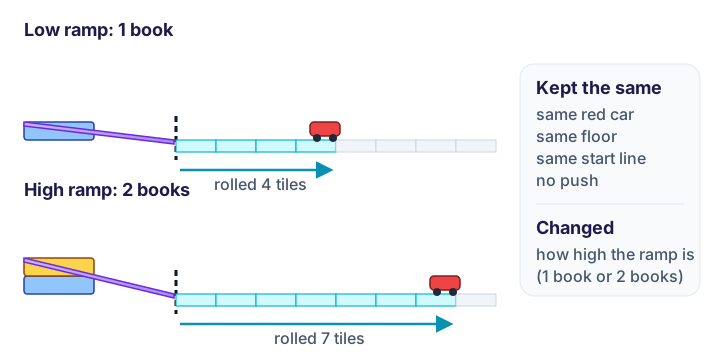
Same car, same floor, same start line. Only the ramp height changes.
Hands-on: Ramp race
About 15 minutes.
You need:
A toy car, or a ball that rolls
Two hardcover books
A flat board or a piece of stiff cardboard
Masking tape or a sticky note for the start line
Paper and a pencil
Steps:
Lean the board on one book. This is the low ramp.
Put tape on the floor at the bottom of the ramp. This is the start line.
Hold the car at the top. Let go. Do not push.
Where did it stop? Count floor tiles or footsteps, or put a sticky note there.
Do it two more times. Write down each result.
Add the second book. Now it is a high ramp. Use the same car and the same start line.
Do it three times again. Write down each result.
Look at your results. Which ramp sent the car farther most of the time?
Practice together
Look at Maya and Leo’s first try. Which two things changed at the same time?
Check your answer
The car changed and the ramp changed. With two changes, they could not tell which one made the difference.
Try it yourself
1. You want to know if a ball bounces higher on a hard floor or on a rug. What will you change? What will you keep the same?
Check your answer
Change the place: floor or rug. Keep the same ball, drop it from the same height, and let go the same way each time, with no throwing.
2. Sam folds two paper airplanes. One has sharp folds and one has soft folds. Sam throws the sharp one hard and the soft one gently. Is that fair? How could Sam fix it?
Check your answer
It is not fair, because two things changed: the folds and the throw. Sam should throw both planes the same way, from the same spot, a few times each.
Talk about it
Why did Maya and Leo try each ramp three times, not just once?
Can you think of a test that was not fair? What would make it fair?
What is hard about keeping everything the same?
Check yourself
1. You want to know if water helps a bean plant grow. Which test is fair?
A. Water one plant and look at it a minute later.
B. One plant by the window gets water. One plant in a dark closet gets no water.
C. Two plants in the same kind of pot by the same window. One gets water and one does not.
Show the answer
C. Two plants in the same kind of pot by the same window. One gets water and one does not.
In the fair test, only the water is different. In the second test the light is different too, so you could not tell what made the difference.
2. Why do we do a test more than once?
A. The first try is always wrong.
B. It makes the test take longer.
C. One try can come out different just by chance.
Show the answer
C. One try can come out different just by chance.
One try can be odd. A bump on the floor or a wobbly start can change it. If the same thing happens again and again, you can trust it more.
3. Remember Lesson 3. When you watch a change, what do you write down first? (Review of L0-03)
A. What you hoped would happen
B. Why it changed
C. What it looked like before and after
Show the answer
C. What it looked like before and after
First write what you saw, before and after. The why comes later, after you test it.
Words to know
- fair test
- A test where you change only one thing, so you can tell what made the difference.
- result
- What happens at the end of a test, like how far a car rolled.
For grown-ups: about this lesson
Why it matters. This lesson introduces controlled comparison, the core of experimental science. In the Next Generation Science Standards, K-2 investigations build toward simple investigations based on fair tests, and planning investigations in which variables are controlled belongs to the grades 3 to 5 band NGSS Lead States, 2013. So the goal here is the idea of changing one thing, not formal variable control. Young children already learn causes from evidence Gopnik & Sobel, 2000; a fair test turns that instinct into a method.
Watch for these mix-ups.
Changing several things at once is quicker, so it is better. (It hides which change mattered.)
One try is enough if the result looks clear. (A single try can be a fluke.)
If the high ramp won, higher ramps always win. (The result holds for this car on this floor; other cars or floors might differ.)
To make it easier. Use one change and two tries for each ramp. Let the child mark stopping spots with sticky notes instead of counting.
To make it harder. Try three ramp heights and draw a picture graph of the results NGA Center and CCSSO, 2010. Ask: does each extra book add the same distance?
Limits. Keeping the things you can see the same does not guarantee that every other cause is the same. A fair test makes a conclusion much more trustworthy, not certain.
On the computer. Grown-ups can see where this idea leads later in Lab: Confounding and intervention, written for older learners.
Sources for this guide. NGSS Lead States, 2013Gopnik & Sobel, 2000NGA Center and CCSSO, 2010
Next: L0-05 · Sure, maybe, or never?
- NGSS Lead States. (2013). Appendix F: Science and Engineering Practices in the NGSS. Next Generation Science Standards. https://www.nextgenscience.org/sites/default/files/Appendix%20F%20%20Science%20and%20Engineering%20Practices%20in%20the%20NGSS%20-%20FINAL%20060513.pdf
- Gopnik, A., & Sobel, D. M. (2000). Detecting Blickets: How Young Children Use Information about Novel Causal Powers in Categorization and Induction. Child Development, 71(5), 1205–1222. 10.1111/1467-8624.00224
- NGA Center and CCSSO. (2010). Common Core State Standards for Mathematics. Common Core State Standards Initiative. https://learning.ccsso.org/wp-content/uploads/2022/11/Math_Standards1.pdf