L0-05 · Sure, maybe, or never?
Some things are sure, some can never happen, and many are maybe. You cannot know one coin flip, but many flips show a pattern.
 Level 0 · Grades 1–3 · about 30 minutes
Big idea. Some things are sure, some can never happen, and many are maybe. You cannot know one coin flip, but many flips show a pattern.
Before this lesson. L0-01, L0-02
Grown-ups. The guide for adults is at the end of this page.
What you will learn
I can sort things into sure, maybe, and never.
I can flip a coin many times and keep a tally.
I can explain why the next flip is still a maybe.
Story: The coin with no memory
Maya and Leo play with a coin. They shake it in a paper cup and tip it onto the table. Heads. Heads again. Then heads a third time!
Leo is sure he knows what comes next. “Three heads in a row. The next one must be tails!” Maya shakes the cup and tips it out. Heads.
“But it was tails’ turn!” says Leo. Maya laughs. “A coin does not keep score. It does not know what it did before. Each flip starts fresh.”
So they flip the coin 20 times. Leo makes tally marks. At the end they count 11 heads and 9 tails. That is not exactly half, but it is close.
“So we can never know one flip,” says Leo. “Right,” says Maya. “One flip is a maybe. But lots of flips show us a pattern.”
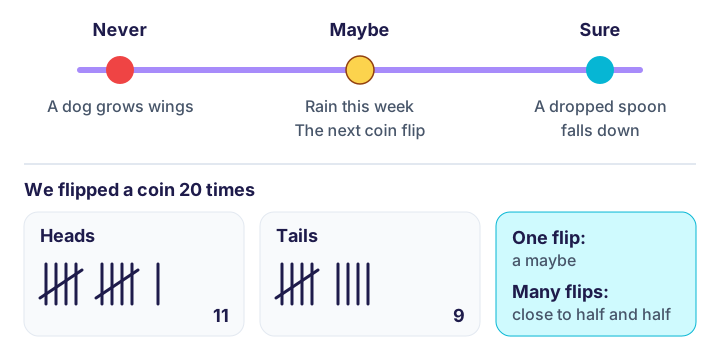
One flip is a maybe. Twenty flips gave 11 heads and 9 tails, close to half and half.
Hands-on: Coin flip tally
About 15 minutes.
You need:
One coin
A paper cup
Paper and a pencil
Five small paper cards, or scraps of paper
Steps:
Draw two boxes on your paper. Write Heads on one box and Tails on the other.
Put the coin in the cup. Cover the top with your hand and shake.
Tip the coin out onto the table. Make a tally mark in the right box.
Do this 20 times. Group your tally marks in fives, like in Lesson 1.
Count each box. Which side came up more? Was it close to half and half?
Now write three new words at the top of a page: Never, Maybe, Sure.
A grown-up writes five cards, like these: The sun will come up tomorrow. A fish will ride a bike. Your next flip is heads. We will have soup tonight. A dropped cup falls down.
Read each card. Put it under Never, Maybe, or Sure.
Talk about it. Why is the next coin flip a maybe?
Practice together
Sort these three together. Ice in a hot pan melts. A teddy bear eats lunch by itself. You will see a bird today.
Check your answer
The melting ice is sure. The teddy bear eating lunch is never, so it is impossible. Seeing a bird today is a maybe, because it can happen or not.
Try it yourself
1. Sam flips a coin and gets tails four times in a row. Sam says, “Heads is next for sure.” Is Sam right?
Check your answer
No. The coin does not remember the last flips. Heads and tails both have the same chance on the next flip. It is a maybe.
2. You put 5 red blocks in a bag and no blue ones. You pull one out without looking. Is getting a red block sure, maybe, or never? What about a blue one?
Check your answer
A red block is sure, because every block in the bag is red. A blue block is never, because there are no blue blocks in the bag.
Talk about it
Why did Leo think tails had to come next? What would you tell him?
Think of something that will happen tomorrow for sure. Now think of a maybe.
If you flipped 100 times, do you think you would get close to half heads?
Check yourself
1. A coin lands heads three times in a row. What about the next flip?
A. It must be heads, because heads keeps winning.
B. It must be tails, because tails is next.
C. It could be heads or tails. No one can know.
Show the answer
C. It could be heads or tails. No one can know.
The coin has no memory. Each flip starts fresh, so the next flip is a maybe.
2. Which one is sure?
A. If you let go of a ball, it falls down.
B. Your next coin flip will be heads.
C. It will be sunny tomorrow.
Show the answer
A. If you let go of a ball, it falls down.
A ball you let go of falls down every time. Sunny weather and heads are both maybes.
3. Remember Lesson 4. In a fair test, how many things do you change? (Review of L0-04)
A. As many things as you can
B. Just one thing
C. Two things at once
Show the answer
B. Just one thing
Change just one thing and keep the rest the same. Then you can tell what made the difference.
Words to know
- chance
- How likely it is that something will happen.
- impossible
- Can never happen.
For grown-ups: about this lesson
Why it matters. This lesson builds everyday chance language (sure, maybe, impossible) and the first idea of probability. A single toss of a fair coin cannot be predicted, but over many tosses the fraction of heads tends to settle near one half, which is how probability describes long-run behavior Barbara Illowsky and Susan Dean, 2023. Twenty tosses is a small sample, so splits such as 12 to 8 or even 13 to 7 are normal and do not mean the coin is unfair.
Watch for these mix-ups.
After several heads, tails is due. (Each toss is independent; the coin has no memory, so the chance stays the same.)
Half and half means exactly 10 heads in 20 flips. (It means about half; 9, 11, or 12 heads is normal.)
Maybe always means fifty-fifty. (Maybe covers everything between never and sure; some maybes are much more likely than others.)
To make it easier. Do 10 flips instead of 20 and sort just three cards. Let the grown-up draw the tally boxes.
To make it harder. Put the whole family’s tallies together for 60 or 100 flips. Is the share of heads closer to half than in one person’s 20 flips? Compare the share (for example 52 out of 100), not the difference in counts, which often gets bigger. Then sort cards onto a line from never to sure, with some maybes nearer one end.
Limits. Twenty flips cannot prove that a coin is fair or that it has no memory; that comes from how coin tosses work, not from one small tally. Real coins can, very rarely, land on their edge, so avoid using “a coin lands heads or tails” as a sure example.
On the computer. Grown-ups can see where this idea leads later in Lab: Chance and repeated trials, written for older learners.
Sources for this guide. Barbara Illowsky and Susan Dean, 2023
Next: L0-06 · Find a pattern and test it
- Barbara Illowsky and Susan Dean. (2023). 3.1 Terminology. OpenStax, Introductory Statistics 2e. https://openstax.org/books/introductory-statistics-2e/pages/3-1-terminology