 Level 0 · Grades 1–3 · about 30 minutes
Big idea. A clue can tell you about something without making it happen.
Before this lesson. L0-04, L0-06
Grown-ups. The guide for adults is at the end of this page.
What you will learn
I can ask, “If I change this on purpose, will that change too?”
I can sort pairs into cause or just a clue.
I can draw arrows to show what causes what.
Story: Hide the umbrellas
It is raining. Maya and Leo look out the window. Lots of people walk by with umbrellas.
Leo laughs. “Every time I see umbrellas, it is raining. Let’s hide all the umbrellas. Then the rain will stop!” Maya giggles. “That will not work. The rain makes people use umbrellas. Umbrellas do not make rain.”
The umbrellas are a clue. They tell you it is raining. But they do not make it rain.
Later, it is hot and sunny. Leo’s mom says the ice cream shop is busy. She says lots of kids get sunburns too. Leo asks, “Does ice cream cause sunburns?”
Maya thinks. “If we stop eating ice cream, will the sunburns stop?” No! The sun is the cause of both. Sunny days bring more ice cream and more sunburns. Ice cream is just a clue.
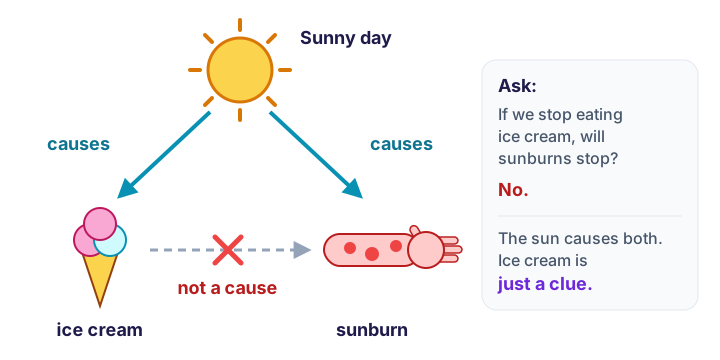
Sunny days cause both. Ice cream does not cause sunburn.
Hands-on: Clue or cause?
About 15 minutes.
You need:
Six paper strips or index cards
A ball that rolls
Crayons or a pencil
A sheet of paper for your arrow picture
Steps:
Your grown-up helps you write one pair on each card.
Use these pairs. Umbrellas and rain. Ice cream and sunburns. Light switch and light. Push a ball and it rolls. Rooster crows and the sun comes up. Clap your hands and you hear a sound.
Read one card. Ask, “If I change the first thing on purpose, will the second thing change?”
If yes, put the card in the Cause pile.
If no, put the card in the Just a clue pile.
Test the safe ones for real. Flip the light switch. Push a ball. Clap your hands.
Pick the ice cream card. Draw a sun with one arrow to ice cream and one arrow to a sunburn.
Practice together
If you open your umbrella inside, will it start to rain outside?
Check your answer
No. Rain makes people open umbrellas. Umbrellas do not make rain. So the umbrella is a clue, not a cause, of rain.
Try it yourself
1. A rooster crows early in the morning, and then the sun comes up. If you make the rooster crow at night, will the sun come up?
Check your answer
No. The crowing is just a clue that morning is near. It does not make the sun rise.
2. You flip a light switch, and the light comes on. You flip it off, and the light goes off. Is the switch a cause or a clue?
Check your answer
A cause. When you change the switch on purpose, the light changes too, again and again.
Talk about it
Can you think of two things that often happen together? Does one make the other happen?
Why was hiding the umbrellas a silly plan?
How could a fair test help you find out if something is a cause?
Check yourself
1. Many people wear coats on cold days. Do coats make the day cold?
A. Yes, coats make the air cold.
B. Yes, because coats and cold days come together.
C. No. Cold days make people wear coats.
Show the answer
C. No. Cold days make people wear coats.
Coats are a clue that it is cold. The cold is the cause. Taking off your coat will not warm up the day.
2. Ice cream sales and sunburns go up on the same days. Why?
A. Hot, sunny days cause both.
B. Sunburns make people want ice cream.
C. Ice cream causes sunburns.
Show the answer
A. Hot, sunny days cause both.
The sun brings both. People buy ice cream when it is hot, and they get sunburns when they play in the sun.
3. Remember Lesson 4. How can you find out if one thing really causes another? (Review of L0-04)
A. Watch one time and guess.
B. Change only that one thing and watch what happens.
C. Change lots of things at once.
Show the answer
B. Change only that one thing and watch what happens.
A fair test changes just one thing on purpose. If the result changes again and again, that thing is likely a cause.
Words to know
- cause
- Something that makes another thing happen.
- clue
- Something that tells you about another thing, but may not make it happen.
For grown-ups: about this lesson
Why it matters. Two things can go together without one causing the other. Sometimes a third thing, a common cause, drives both (sunny weather drives ice cream sales and sunburns); sometimes one does cause the other but only in one direction (rain causes umbrellas, not the reverse). Telling association from causation, and asking what would happen under an intervention, is the heart of causal inference Pearl, 2009. Young children already learn causal structure from patterns of evidence, including what happens when they act on the world Gopnik et al., 2004. The question “If I change this on purpose, will that change?” is the idea behind the fair test in Lesson 4.
Watch for these mix-ups.
If two things always happen together, one must cause the other. (A third thing may cause both, as the sun does.)
If A goes with B, then A causes B. (It may be the other way round: rain causes umbrellas.)
A clue is useless. (Clues help us predict; they just do not tell us what to change.)
To make it easier. Use three cards: umbrellas and rain, light switch and light, ice cream and sunburns. Act out the light switch together first.
To make it harder. Ask the child to invent a new pair where a third thing causes both, then draw the arrow picture. For example, a cold day causes both coats and frosty windows. Answer key for the six cards: light switch, push a ball, and clap are causes; umbrellas, ice cream, and rooster are clues (rain, the sun, and morning are the real causes).
Limits. For most cards the child answers the “change it on purpose” question by thinking, not by testing, so the sort is a reasoned guess. Only a real fair test can settle it. Also, a clue can sometimes be a cause too; the lesson teaches that going together does not have to mean causing, not that it never does.
On the computer. Grown-ups can see where this idea leads later in Lab: Confounding and intervention, written for older learners.
Sources for this guide. Pearl, 2009Gopnik et al., 2004
Next: L0-10 · Meet the big ideas
- Pearl, J. (2009). Causal inference in statistics: An overview. Statistics Surveys, 3(none), 96–146. 10.1214/09-ss057
- Gopnik, A., Glymour, C., Sobel, D. M., Schulz, L. E., Kushnir, T., & Danks, D. (2004). A Theory of Causal Learning in Children: Causal Maps and Bayes Nets. Psychological Review, 111(1), 3–32. 10.1037/0033-295X.111.1.3