 Level 0 · Grades 1–3 · about 30 minutes
Big idea. Sort with one clear rule, then count each group.
Before this lesson. L0-01
Grown-ups. The guide for adults is at the end of this page.
What you will learn
I can pick one rule and use it to sort.
I can say where the tricky things go.
I can make a picture graph and find the biggest group.
Story: The tricky button
Maya and Leo open a treasure box full of buttons. “Let’s sort them,” says Maya. “Our rule is color. Red ones here. Blue ones there.”
It goes well until Leo picks up a button that is half red and half blue. “It goes with the red ones,” he says. “No, blue!” says Maya. They both hold on to it.
“Wait,” says Maya. “Our rule does not say what to do with this one.” So they add to the rule. Buttons with two colors get their own group. Now every button has just one place to go.
They count each group, one button at a time. Red has 5. Blue has 4. Two colors has 2. Then they make a picture graph with one square for each button. The red row is the longest, so red has the most.
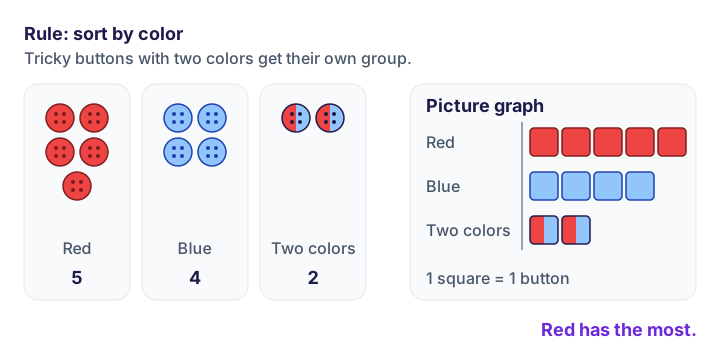
The rule is color. Tricky buttons with two colors get their own group. The graph shows red has the most.
Hands-on: Sort the treasure box
About 20 minutes.
You need:
10 to 20 small things, like buttons, blocks, pasta shapes, or toy pieces
A few bowls or pieces of paper to hold the groups
Grid paper, or plain paper and a crayon
A pencil
Steps:
Put all your things in one pile. Look at them closely.
Pick one rule, like color, size, or shape. Say your rule out loud.
Look for tricky things that could fit two groups. Decide where they go, before you sort.
Sort everything into 2, 3, or 4 groups. Use one bowl or paper for each group.
Count each group. Touch and move each thing, like in the last lesson.
Make a picture graph. Draw one square for each thing, in a row for each group.
Look at your graph. Which group has the most? Which has the fewest?
Mix everything up. Pick a new rule and sort again. Do the groups change?
Practice together
Leo sorts socks by color. He finds a sock with red and white stripes. Where should it go?
Check your answer
The rule has to say. He could make a group for socks with stripes or two colors. Then every sock has just one place to go.
Try it yourself
1. You sort toy animals by how many legs they have. You have a snake, a duck, a cat, and a dog. Which groups do you make?
Check your answer
Make three groups. The snake goes in no legs. The duck goes in two legs. The cat and the dog go in four legs.
2. A picture graph shows 6 squares for blocks and 3 squares for balls. Which group has more? How many more?
Check your answer
Blocks have more. There are 3 more blocks, because 6 is 3 more than 3.
Talk about it
What happened when Maya and Leo found the tricky button?
Can you sort the same things with a different rule? What changes?
Where do people sort things at home or at the store?
Check yourself
1. Remember Lesson 1. Why do you move each thing after you count it? (Review of L0-01)
A. So you can count faster
B. So you count each thing just once
C. So the pile looks neat
Show the answer
B. So you count each thing just once
When you move a thing as you count it, you will not count it twice or skip it.
2. Leo puts all the cars in one group and all the red toys in another group. What is the problem?
A. He should have sorted by size.
B. He used two rules, so a red car could go in both groups.
C. He needs to make more groups.
Show the answer
B. He used two rules, so a red car could go in both groups.
One rule gives each thing just one place. With two rules, a red car fits both groups.
3. In a picture graph, red has 5 squares and blue has 4 squares. How many more red buttons are there?
A. 9
B. 1
C. 5
Show the answer
B. 1
Line up the rows. Red has one square more than blue, so there is 1 more red button. Nine is how many there are in all.
Words to know
- sort
- To put things into groups that go together.
- rule
- What tells you which group each thing goes in.
- picture graph
- A chart with one square or picture for each thing.
For grown-ups: about this lesson
Why it matters. Sorting objects into categories and counting each one is a kindergarten goal (K.MD.3). Organizing data into up to three categories comes in grade 1 (1.MD.4), and drawing a picture graph with up to four categories comes in grade 2 (2.MD.10) NGA Center and CCSSO, 2010. The tricky button teaches a deeper point: a good category rule must say where every object goes, with no object in two places.
Watch for these mix-ups.
One rule can put a thing in two groups. (A clear rule gives each thing exactly one place; add a group for the tricky ones.)
The group that takes up the most space has the most. (Spread-out groups look bigger; count them, or use squares of the same size in the graph.)
There is only one right way to sort. (Many rules work; what matters is that the rule is clear and used the same way each time.)
To make it easier. Use two groups and about 10 things. Draw the picture graph together, one square at a time.
To make it harder. Sort the same things by two different rules and make a graph for each. Ask which rule gave the biggest group, and why the graphs are different.
Limits. Groups come from the rule people choose. A different rule gives different groups and different counts, so a picture graph only tells you about the rule that was used. Which group is biggest says nothing yet about why.
On the computer. Grown-ups can see where this idea leads later in Lab: Chance and repeated trials, written for older learners.
Sources for this guide. NGA Center and CCSSO, 2010
Next: L0-03 · Watch a change
- NGA Center and CCSSO. (2010). Common Core State Standards for Mathematics. Common Core State Standards Initiative. https://learning.ccsso.org/wp-content/uploads/2022/11/Math_Standards1.pdf