L0-06 · Find a pattern and test it
A pattern helps you guess what comes next. But a guess is not done until you test it.
 Level 0 · Grades 1–3 · about 30 minutes
Big idea. A pattern helps you guess what comes next. But a guess is not done until you test it.
Before this lesson. L0-01, L0-03
Grown-ups. The guide for adults is at the end of this page.
What you will learn
I can measure a cup tower and write the height.
I can find a pattern and use it to make a guess.
I can test my guess and say what really happened.
Story: The cup tower
Maya and Leo have a pile of paper cups that are all the same. They want to build a tower by putting one cup inside the next. How tall will 6 cups be?
Leo measures one cup with a ruler. It is 9 centimeters tall. “Easy,” he says. “Six cups is 9 and 9 and 9 and 9 and 9 and 9. That is 54!”
Maya puts a second cup inside the first. She measures again. The tower is only 10 centimeters! “The new cup sits inside the old one,” she says. “Only the top part sticks out.”
They add a third cup. Now it is 11 centimeters. Leo sees a pattern. “The first cup is 9. Each new cup adds 1 more.” So they predict 6 cups will be 14 centimeters.
Is the guess right? They build it to find out. The ruler says 14. “Our pattern passed the test,” says Maya. “Now we know it worked for 6 cups.”
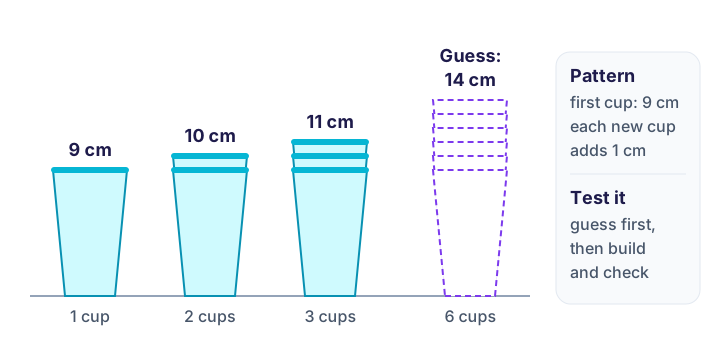
Maya and Leo’s cups. Each new cup added about 1 cm. Your cups may give other numbers.
Hands-on: Cup tower
About 20 minutes.
You need:
Six paper or plastic cups that are all the same
A ruler with cm on it
Paper and a pencil
Steps:
Stand one cup on the table. Hold the ruler straight up next to it, with 0 at the table.
Read the number at the top of the cup. Write it down.
Put a second cup inside the first. Measure the tower again. Write it down.
Add a third cup. Measure and write it down.
Look at your numbers. How much did each new cup add? That is your pattern.
Use your pattern to predict how tall 6 cups will be. Write it as My guess.
Build the tower with 6 cups. Measure it. Write it as What happened.
Was your guess close? If not, what could have changed?
Practice together
Maya and Leo’s tower was 9 centimeters with 1 cup, 10 with 2 cups, and 11 with 3 cups. How tall do you think 4 cups will be?
Check your answer
12 centimeters. Each new cup added 1 more, so 11 and 1 more is 12. To be sure, you would build it and measure.
Try it yourself
1. Sam has bigger cups. Sam measures one cup. It is 12 centimeters tall. Each new cup adds 2 centimeters. How tall will 3 cups be?
Check your answer
16 centimeters. Start at 12. Add 2 for the second cup to get 14. Add 2 more for the third cup to get 16.
2. A bean plant grew 1 cm each day for 3 days. Leo says, “In 100 days it will be 100 centimeters taller.” Is that sure?
Check your answer
No, it is only a guess. A plant can grow faster or slower, or stop growing. The way to know is to keep measuring and see.
Talk about it
Why was Leo’s first guess of 54 so far off?
Your numbers may not match Maya and Leo’s. Why could that be?
Can you think of a pattern that might stop working one day?
Check yourself
1. A tower is 9 cm with 1 cup, 10 cm with 2 cups, and 11 cm with 3 cups. What is a good guess for 6 cups?
A. 54 cm
B. 14 cm
C. 22 cm
Show the answer
B. 14 cm
Each new cup adds 1 cm. Count up from 11: 12, 13, 14. The 54 guess forgets that the cups sit inside each other.
2. Why do Maya and Leo build the 6 cup tower after they guess?
A. Because a guess is always wrong
B. To test if the pattern really works
C. So they do not have to measure
Show the answer
B. To test if the pattern really works
A pattern is a good way to guess, but a guess can be wrong. Building and measuring is the test.
3. Remember Lesson 5. Maya flipped a coin 20 times and got 11 heads. What will her next flip be? (Review of L0-05)
A. Heads, because heads won.
B. No one can know. It is a maybe.
C. Tails, so it can even out.
Show the answer
B. No one can know. It is a maybe.
The coin has no memory. Many flips show a pattern, but one flip is still a maybe.
Words to know
- pattern
- Something that happens the same way again and again.
- predict
- To make a careful guess about what will happen.
- centimeters
- Small steps on a ruler, marked cm.
For grown-ups: about this lesson
Why it matters. Children measure length with a ruler, starting at zero and reading whole centimeters, which matches the grade 2 measurement standard NGA Center and CCSSO, 2010. Nested cups make a simple, honest pattern: the first cup gives the full height and each extra cup adds only the rim step. Measuring and writing down each height before predicting continues the K-2 practice of making careful observations NGSS Lead States, 2013. The key habit is treating a prediction for a new case as a real test that the pattern might fail.
Watch for these mix-ups.
Six cups must be six times as tall as one cup. (Nested cups only add the part that sticks out, so measure two or three before you predict.)
If a pattern worked three times, it will always work. (It is still a guess until you test it on a new case, and patterns can stop working.)
You measure from the very end of the ruler. (Many rulers have a gap before the 0 line; line up 0 with the table.)
To make it easier. If reading a ruler is hard, stand a paper strip beside the tower and draw a pencil line at the top each time; compare the gaps between the lines. Predict 4 cups instead of 6.
To make it harder. Predict 10 cups, then build and check. Try a different kind of cup and compare the two patterns. Plot height against number of cups on squared paper.
Limits. The rim step is rarely perfectly even, and readings to the nearest centimeter can be off by one, so a guess that is close counts as a good result. One successful prediction supports the pattern for this case; it does not prove the pattern works for any number of cups.
On the computer. Grown-ups can see where this idea leads later in Lab: Chance and repeated trials, written for older learners.
Sources for this guide. NGA Center and CCSSO, 2010NGSS Lead States, 2013
Next: L0-07 · Use light to ask a question
- NGA Center and CCSSO. (2010). Common Core State Standards for Mathematics. Common Core State Standards Initiative. https://learning.ccsso.org/wp-content/uploads/2022/11/Math_Standards1.pdf
- NGSS Lead States. (2013). Appendix F: Science and Engineering Practices in the NGSS. Next Generation Science Standards. https://www.nextgenscience.org/sites/default/files/Appendix%20F%20%20Science%20and%20Engineering%20Practices%20in%20the%20NGSS%20-%20FINAL%20060513.pdf