L0-10 · Meet the big ideas
This course joins three big ideas. What makes things happen. The surprising world of very tiny things. Machines that learn from examples.
 Level 0 · Grades 1–3 · about 30 minutes
Big idea. This course joins three big ideas. What makes things happen. The surprising world of very tiny things. Machines that learn from examples.
Before this lesson. L0-07, L0-08, L0-09
Grown-ups. The guide for adults is at the end of this page.
What you will learn
I can name the three big ideas of this course.
I can put an idea in the circle where it fits.
I can tell three things I learned.
Story: The big idea poster
Maya and Leo want to make a poster. They write one thing they learned on each sticky note. Soon they have a big pile.
Leo picks up a note. It says, “Ice cream is just a clue.” Maya says, “That one is about causes.” She draws a circle and writes Causes on it.
Next is “A bit holds 1 or 0.” Maya says, “Computers store things with bits. Learning machines run on computers.” Leo adds, “Later we will meet a quantum bit. It follows the rules of very tiny things.” So Maya draws two more circles, Tiny things and Learning machines. She makes them overlap.
The bit note goes where Tiny things and Learning machines overlap. “A pattern is not always a cause” goes between Causes and Learning machines.
Leo points to the very middle, where all three circles meet. “What goes here?” Maya smiles and writes, “This course!”
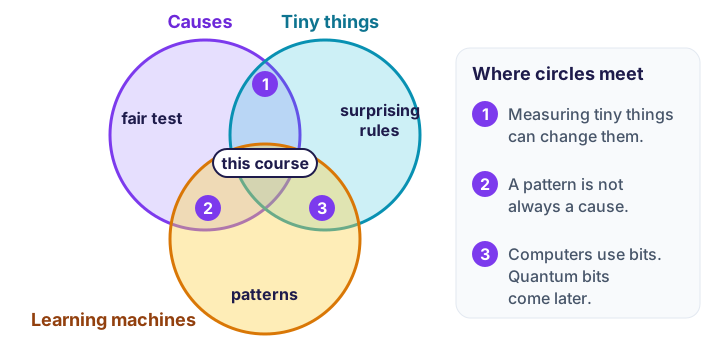
Three big ideas. This course lives in the middle, where all three meet.
Hands-on: Big ideas sort
About 20 minutes.
You need:
A big sheet of paper
Crayons or markers
Sticky notes or small paper squares
Steps:
Draw three big circles that overlap, like the picture.
Write a name on each circle. Causes. Tiny things. Learning machines.
With your grown-up, write one idea on each note. Use five or six ideas.
Here are some ideas to use. A fair test. A clue is not a cause. Tiny things follow surprising rules. A bit holds 1 or 0. A pattern helps you guess.
Read each note. Which circle does it fit? Put it there.
If a note fits two circles, put it where they overlap.
Write “this course” in the middle, where all three circles meet.
On the back, finish this. Three things I learned in Level 0 are...
Practice together
Where does the note “A fair test changes one thing” go?
Check your answer
In the Causes circle. A fair test is how we find out what makes things happen.
Try it yourself
1. Where does the note “Light and very tiny things follow surprising rules” go?
Check your answer
In the Tiny things circle. You will learn about those rules later in the course.
2. A learning machine finds that umbrellas and rain go together in its examples. Does the pattern show which one is the cause?
Check your answer
No. A pattern is not always a cause. So this note can go where Causes and Learning machines overlap.
Talk about it
Which big idea are you most excited to learn about? Why?
Which note was the hardest to place? Where did you put it?
What is one question you still have?
Check yourself
1. What do learning machines do?
A. They think just like people do.
B. They always know why things happen.
C. They find patterns in lots of examples.
Show the answer
C. They find patterns in lots of examples.
Learning machines look at lots of examples and find patterns. A pattern can help with a guess. It does not always show a cause.
2. Which one is a big idea of this course?
A. Counting, sorting, and coin flips.
B. Ramps, flashlights, and cards.
C. The surprising world of very tiny things.
Show the answer
C. The surprising world of very tiny things.
We used counting, ramps, and cards to practice. But the three big ideas are causes, very tiny things, and learning machines.
3. Remember Lesson 8. The cards are up, down, down. How do you write that? (Review of L0-08)
A. 0 1 1
B. 1 1 0
C. 1 0 0
Show the answer
C. 1 0 0
Face up is 1 and face down is 0. So up, down, down is 1 0 0.
Words to know
- learning machine
- A computer program that finds patterns in lots of examples.
- overlap
- When two shapes share some space.
For grown-ups: about this lesson
Why it matters. This lesson closes Level 0 by naming the three strands the whole course weaves together. The first is causal inference: telling a clue (an association) from a cause, and using interventions like fair tests to find out Pearl, 2009. The second is the world of the very small: light and the tiniest bits of matter follow rules that differ from everyday experience, and the course later meets the quantum bit, a basic unit of quantum information Basics of quantum information, n.d.. The third is machine learning: systems that find patterns in many examples. The overlaps matter most: a learning system finds associations, and an association is not always a cause.
Watch for these mix-ups.
Learning machines think or understand like people. (They find patterns in data; that is useful but different.)
A quantum bit is just a smaller ordinary bit. (It follows different rules, met in later levels; simple everyday pictures of it can mislead.)
The flashlight lesson showed the surprising quantum rules. (Lesson 7 was about ordinary light and seeing; the surprising rules come much later.)
To make it easier. Use only two circles, Causes and Learning machines, with three notes. Add the third circle another day. A placement key for the suggested notes: a fair test and a clue is not a cause go in Causes; a pattern helps you guess goes in Learning machines; a bit holds 1 or 0 goes where Tiny things and Learning machines overlap; tiny things follow surprising rules goes in Tiny things. The picture’s note that measuring tiny things can change them previews a later idea; it is not shown in Level 0.
To make it harder. Ask the child to write one new note for each overlap and explain where it goes. Keep the notes for the start of Level 1.
Limits. This lesson only names the three ideas. It does not teach how quantum systems or learning machines work, and the circle sort has no single right answer for every note. Placement is a way to talk, not a test.
On the computer. Grown-ups can see where this idea leads later in Lab: Confounding and intervention, written for older learners.
Sources for this guide. Pearl, 2009Basics of quantum information, n.d.
Next: L1-01 · Fractions describe part of a whole
- Pearl, J. (2009). Causal inference in statistics: An overview. Statistics Surveys, 3(none), 96–146. 10.1214/09-ss057
- Basics of quantum information. (n.d.). https://quantum.cloud.ibm.com/learning/en/courses/basics-of-quantum-information