L0-01 · Count what you can see
Count each thing just once, and write your count down so anyone can check it.
 Level 0 · Grades 1–3 · about 30 minutes
Big idea. Count each thing just once, and write your count down so anyone can check it.
Before this lesson. Nothing. Start here.
Grown-ups. The guide for adults is at the end of this page.
What you will learn
I can touch and move each thing as I count it.
I can keep my count with tally marks.
I can tell which of two piles has more.
Story: The button mix-up
Leo finds a jar of buttons. He pours them in a pile on the table. He points and counts fast. “Thirteen!” he says. Then he counts again. “Fifteen?” Now he has two answers.
Maya looks at the pile. “I think you counted some buttons twice,” she says. “And you skipped some too. They are all mixed up.”
Maya shows him a better way. She touches one button and moves it to a new spot. She says, “One.” She moves the next one and says, “Two.” Each button moves only once, so it is counted only once.
For each button, Leo draws a tally mark. After four lines, the fifth line goes across them. That makes a group of five. Groups of five are easy to count again.
The last number Maya says is fourteen. Leo counts the tally marks and gets fourteen too. Then Leo’s dad counts the buttons. Fourteen again! Now anyone can check their count.
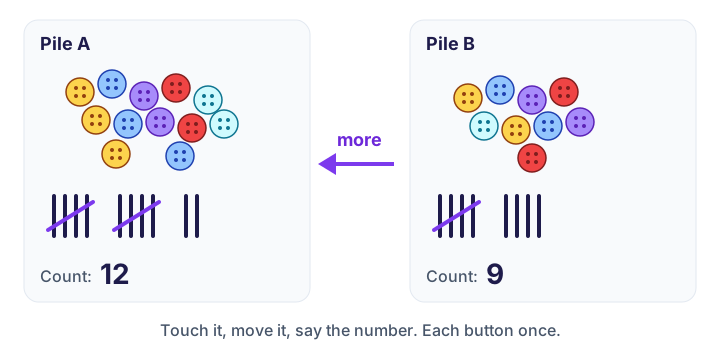
Two new piles, like the ones you will count. Each button gets one tally mark. Pile A has 12. Pile B has 9. Pile A has more.
Hands-on: Count and tally
About 15 minutes.
You need:
Two small piles of things, with 8 to 15 in each, like buttons, blocks, or dry pasta
Two pieces of paper
A pencil
Steps:
Make two piles. Call them Pile A and Pile B. Write each name at the top of a paper.
Start with Pile A. Touch one thing and move it to a new spot. Say, “One.”
Draw one tally mark on the Pile A paper.
Keep going. Move one thing, say the next number, and draw one mark.
When you draw the fifth mark, draw it across the other four.
Write the last number you said under your tally marks.
Now count Pile B the same way, on its own paper.
Look at your two numbers. Which pile has more? Circle that number.
Ask a grown-up to count both piles. Do they get the same numbers?
Practice together
Leo has these tally marks: one group of five and three more lines. How many things did he count?
Check your answer
Eight. Count the group as five, then go on: six, seven, eight.
Try it yourself
1. You count 7 spoons. Then your little brother spreads them out on the table. How many spoons are there now?
Check your answer
There are still 7. Moving things does not change how many there are. You can count again to check.
2. Pile A has 10 blocks. Pile B has 12 blocks. Which pile has more? How do you know?
Check your answer
Pile B has more, because 12 is more than 10. When you count, you say 12 after you say 10.
Talk about it
Why did Leo get two different answers the first time?
Why is it good to write your count down?
What things at home would be hard to count? Why?
Check yourself
1. Maya touches each shell and says, “One, two, three, four, five, six.” How many shells are there?
A. You have to count again to know
B. Six
C. Five
Show the answer
B. Six
The last number you say tells you how many. She said six last, so there are six shells.
2. How do you draw the fifth tally mark?
A. As a line across the first four
B. As a circle around the first four
C. As one more line standing next to the others
Show the answer
A. As a line across the first four
The fifth line goes across the four. Then you can see a group of five at a glance.
3. Leo counts a pile of blocks two times. He gets 9 and then 11. What should he do?
A. Pick 11, because it is the bigger number
B. Count again, and move each block as he counts it
C. Pick 9, because it came first
Show the answer
B. Count again, and move each block as he counts it
Two different answers mean there was a mix-up. Moving each block as you count it stops you from counting one twice or skipping one.
Words to know
- tally mark
- A short line you draw for each thing you count.
- check
- To look again to see if something is right.
For grown-ups: about this lesson
Why it matters. Counting to answer “how many?” and comparing two numbers are kindergarten goals in the Common Core (K.CC.5 and K.CC.6) NGA Center and CCSSO, 2010. Two habits sit underneath them: say one number for each object, and know that the last number said tells how many. Touch-and-move counting makes the first habit physical. Tally marks add a written record that another person can check, which is the start of honest data.
Watch for these mix-ups.
Counting fast is counting well. (Speed causes skips and double counts; slow down and move each object as you count it.)
Spreading things out makes more of them. (Spread a counted pile out and count again to show the number stays the same.)
Two different counts mean somebody did it wrong on purpose. (Mix-ups are normal; a careful recount finds them.)
To make it easier. Use one pile of 5 to 10 things and skip the tally. Say each number together as the child moves each object.
To make it harder. Use piles of 15 to 25 things. Ask the child to guess the total first, then count and see how close the guess was.
Limits. This lesson works with small, still groups that are easy to see. Real counts can be harder, for example when things move or hide. A recount by a second person makes a count more trustworthy, but it can still miss things.
On the computer. Grown-ups can see where this idea leads later in Lab: Chance and repeated trials, written for older learners.
Sources for this guide. NGA Center and CCSSO, 2010
Next: L0-02 · Make clear groups
- NGA Center and CCSSO. (2010). Common Core State Standards for Mathematics. Common Core State Standards Initiative. https://learning.ccsso.org/wp-content/uploads/2022/11/Math_Standards1.pdf